The Lunchbox: Out of the Box
April 26th, 2014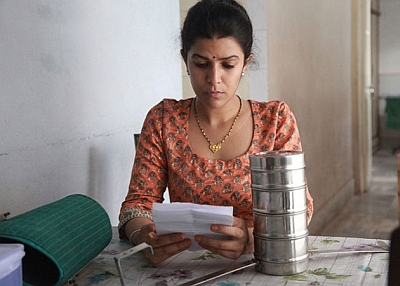
Nimrat Kaur stars as Ila in The Lunchbox
While enjoying favorable reviews from both audiences and critics, the English language press within and outside India has not seemed to appreciate many of the ironies and nuances in Ritesh Batra’s film, The Lunchbox.
To be sure, nearly every American reviewer notes the similarities to The Shop Around the Corner (1940) and its 1998 adaptation, You’ve Got Mail, with Meg Ryan and Tom Hanks (although email is conspicuously absent from The Lunchbox). Regardless of their nationality, reviewers delight in the many gentle understatements of the film. We hear the voice of venerable star of the Hindi screen, Bharti Achrekar, but she never appears, remaining unseen as an upstairs auntie offering a neglected young neighbor advice on love and condiments. We hear the sound-track from Saajan, a 1990s blockbuster Bollywood production whose title character shares the name of the quiet and lonely Lunchbox protagonist.
However, most reviews I’ve read ignore many of the multicultural intersections (and collisions) that occur throughout the film. Viewers unfamiliar with India may miss them entirely, while Indian reviewers may simply take them for granted. And they shouldn’t.
So I wonder if Indian reviewers leave them unmentioned because, unlike me, an American who has lived in India, they no longer consider noteworthy the little things that grab a foreigner? Could it be that educated Indian urbanites in the world’s largest democracy are so used to their pluralism that they no longer consider it worth commentary?
Yet, I cannot help but see The Lunchbox through the filter of India, now in the frenzy of national elections.Sectarian apprehensions are shared by many Muslims and other non-Hindu Indians whose concerns have been exacerbated by the overwhelming popular support garnered by Narendra Modi, a self-described Hindu nationalist, who may become India’s next prime minister.
Pluralism is endangered wherever people listen only to those just like themselves. Through its excellent casting and the story the actors tell, The Lunchbox demonstrates that tolerance is maintained by pluralism.
Am I reading too much into what I see as small coded signs?Perhaps…
But intentional or not, the messages are as delectable as the notes exchanged by the lovelorn couple at the center of the film.
Synopses and reviews of the film have appeared in scores of other print and digital publications. Suffice it so say that I found the film extremely satisfying. What concerns me here in this post are things other viewers might enjoy contemplating before they see The Lunchbox.
Even though The Lunchbox is in Hindi (with subtitles), the two lonely hearts correspond in English, on paper. While this may have been a device to expand the film’s appeal outside India, millions of Indians are multilingual, and they choose the medium of English to transcend religion, geography, and community affiliations.
Export product or not, director Batra eschews the stock exoticism of films made in India for foreign audiences. No frames of multi-armed temple deities, no cows blocking rush-hour traffic, no silhouetted minarets and calls to prayer, no Kashmiri houseboats and sunsets with fishermen, palm-shaded Raj bungalows—and no Slumdog hovels. In short, the film is virtually devoid of the audio and visual clichés of sectarian, historical, and geographical color. Could this restraint have been the director’s way to quietly champion the Indian pluralism now endangered by the polarities of politics?
Whether the multicultural intersections I note below were intentional or simply serendipitous and not consciously included, recognizing them added much to my own enjoyment of the film:
Saajan Fernandes, a retiring Goan Christian, accountant and widower, is played by the internationally acclaimed secular Muslim film star, Irrfan Khan. Nightly, Saajan smokes on his balcony and watches wistfully as Christian neighbors share their family dinner beneath a framed print of The Last Supper.
Sikh actress and star of an Indian Cadbury chocolate TV commercial, Nimrat Kaur fills the role of the unappreciated Hindu wife, Ila, Though named for the Hindu goddess of speech, Ila has little spoken dialogue. Nonetheless, she communicates volumes with a glance and through her culinary accomplishments, which include an array of sophisticated vegetarian dishes. The lunches she prepares tell us Ila has more than enough for her household budget— she offers two starches: chappatis, of course, but also a costlier rice pilau flecked with coriander leaves.
Despite its grime, anyone who knows Mumbai can read the setting—the paved streets, locked gates, tiled bathrooms, indoor tap water– all signs of the middle class. We know that Saajan has made it; he has his own house and can watch movies on his VCR. Ila and her indifferent husband fixated on his smartphone are still ascending, but middle-class enough to have had a honeymoon and afford taxis, dabbawallah lunch deliveries, and their daughter’s daily rickshaw transport to a private school.
Nawazuddin Siddiqui, a Muslim actor, plays Shaikh, the obsequious but endearing striver and con-artist. Shaikh is proud of his cooking skills and ability to get a counterfeit rail pass. Though poor and lunching on no more than a banana, he invites his office mentor, Sajaan, to dinner to share his specialty, a lamb dish. With Shaikh’s fiancée, the three sit on the floor to eat… a sign that the betrothed couple have a way to go before they can buy a dinette set.
The insurance office stacked with paper files, where the soon-to-retire Saajan is supposedly easing Shaikh into his job, is headed by an English-speaking sophisticate. Mr. Shroff, whose surname is derived from the word for money-changer, is a Gujarati, likely a member of the mercantile Parsi community.
Shaikh’s wedding is not the Indian family dream of a no-holds-barred opportunity for conspicuous consumption. His is reduced to a generic civil ceremony at which the Christian Sajaan represents the orphan Muslim Shaikh’s “family.” There is the usual tinseled groom (in a rented jacket) and red bridal sari, but no other trappings that tell us much about the couple except that they are not people of means.
To strip the glitz from an Indian wedding– no songs, no dances, no horses, elephants or cascades of rosebuds and jasmine… now that’s minimalism.
Like the film’s eponymous tiered steel food containers delivered to millions of Mumbai desks each workday, The Lunchbox presents many well-seasoned layers with tastes that linger long after the meal.