Living on $42.00 Per Week Redux
June 1st, 2008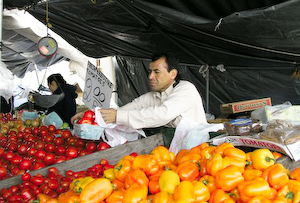
Vendor at the Red Barn, Bradenton
You may have noticed that we haven’t been posting for a couple of weeks. What began as a glitch with one of our Websites escalated to become a calamity for all of them, causing us to leave our former hosting service and sign on with a new one (thanks to a very practical referral from our new friend, Skip Dyrda). But we’ve put all the pieces back together, so now we’re back in business.
As we’ve made this transition, we’ve been reviewing the archived content of our sites. We’re surprised to find that it’s been nearly a year since we chronicled our experiment, Living on $42.00 per Week, shopping and dining within the Food Stamp budget. Having reviewed our experience, we thought it would be a good idea to reflect on where we’ve been and where we’re headed in the year to come.
The stark answer is that we don’t know. The changes we’ve made in our lives since last year have more to do with energy conservation than diet.
Given what has happened to the cost of fuel, and how that has affected virtually every other service and product we use, our thoughts have gone far beyond the inadequacies of the Food Stamp program.
One of our friends, who runs a deli in Sarasota, says the Italian-American bakery delivering his fresh bread has raised the price three times since February. But the Publix 5-pound bag of unbleached flour had been the same price for a year—until a few weeks ago. That tells us that there weren’t too many other home bakers depleting existing shelf stock. However, a product requiring less time and manipulation than flour—dried pasta—has doubled in price.
The retail prices of virtually all foods have risen over the course of the past year—most dramatically in the last four months. Eggs and milk have been climbing steadily and grain products have bolted. Crude oil gets a lot of press, but the increased volatility of food commodities make trading in rice, wheat, and corn qualify as an extreme sport.
Canned goods have gone up, too, and we see far fewer specials. There doesn’t seem to be a 14 oz. tin of anything on offer for less than half a dollar. Where have those once-frequent two-for-one sales gone?
Up at Bradenton’s Red Barn, our former haunt for produce, a week’s worth of fresh vegetables herbs, and fruit for two cooks like us now costs $14 – $16 per week. Last year, we usually spent $10 – $11.
So we are shopping closer to home, buying more things from the Saturday morning market downtown—whether our purchases are the pricey organic items or “conventional” produce from the wholesale market in Tampa. If we factor in gas at $4 a gallon, we save the 25 mile round-trip to Bradenton and at least a gallon of gas by staying here in town. And we give up two things we really care about: the broader selection of Latin produce and the pleasure of eavesdropping on fellow shoppers chatting in Spanish, Portuguese, Arabic, and a host of Asian and Slavic languages.
Gas, of course, is the big topic of conversation for everyone today—up a third from the price this time last year. We, the cheerful, resourceful foodies. have to admit: it casts a cloud over our daily lives.
The Farm Bill—which contains amendments to the Food Stamp program—remains in limbo. Anticipated are: Congressional approval, Presidential veto, and ultimate override of the veto. How much the weekly Food Stamp allotment stood to increase—if at all—was never clear.
But we stand firm on one thing: Food Stamps won’t alleviate American hunger and malnutrition unless education is a major component of the program. Rampant obesity among our poorest citizens demonstrates that knowing how to choose and prepare nutritionally and economically sensible meals is not an innate skill.
Even for people as savvy as we consider ourselves to be, the grocery store can be a hornet’s nest of nutritional traps. Last week we bought a loaf of multi-grain whole wheat bread only to discover later, on tasting, that it was heavily sweetened. Why? High fructose corn syrup prolongs shelf life for all those centrally baked loaves trucked around the country. It’s not only wheat prices that are making your daily bread more costly. Oil runs farm equipment, the power plants that keep bread ovens baking, and the trucks that deliver the bread.
We’re all caught in the same down-draft but we’d like to think we can help you cope as we and others rethink, adapt, and innovate.
For starters, we’re using our pressure cooker a lot more now. We’ve written about how easy—and energy-efficient—it is to cook beans. Of late, we’ve expanded our repertoire to include potatoes, yams, and beets. We’ve found them to be perfectly whole and cooked through with just five minutes under pressure. After that, we turn off the heat, not opening the cooker until at least an hour later (when the pot has cooled). And if you don’t open the lid and break the seal, the veggies can wait for more than a day, unrefrigerated, until you need them.
As we’ve said, nutritional/culinary education is vital. A can of tuna, beyond serving as the base for the all-American tuna salad, can become Salad Niçoise, Provençal tuna salad; Condiglione, Italian tuna salad; Pain Bagnat, tuna grinder from the South of France; or Pasta with Tuna Sauce. This information is readily available on the Internet—from library computers if necessary—and in cookbooks from library shelves. And none of these dishes requires a can of cream of mushroom soup.
Think about foods that can be multi-purpose. As we wrote last year, a take-out rotisserie chicken—although not eligible on the Food Stamp allotment—can be two, and possibly three, meals for two people.
If you must snack, make it carrot sticks. Those zany “home economists” from a couple of generations ago certainly didn’t know half of what we know today about basic nutrition, but they had the right idea. While high fructose corn syrup may not be the nutritional demon it’s been made out to be, it remains insidious, unnecessary, and best avoided when possible.
If we could impart only one piece of advice, it would be: Share your meals. Turn off the TV; don’t answer the phone.Whatever you bring to the table, sit down with the people you love. Make the time.
Links to the rest of the posts in our series:
Living on $42.00 Per Week—the Challenge
Living on $42.00 Per Week—Day 1
Living on $42.00 Per Week—Day 2
Living on $42.00 Per Week—Day 3
Living on $42.00 Per Week—Day 4
Living on $42.00 Per Week—Day 5
Living on $42.00 Per Week—Day 6
Living on $42.00 Per Week—Day 7
Living on $42.00 Per Week—Summary
[ad#bottom]