Living on $42.00 per Week-Day 2
July 17th, 2007Here is a brief follow-up to our first day’s culinary adventures.
On Sunday afternoon, we went to Whole Foods, where we bought approximately 3 Lbs. of a halibut frame. For those who may not know that term, it’s merely the carcass, left over after the fish has been filleted. Whole Foods will be happy to sell you all or part of a fish frame (also known as a rack) for $1.99 per pound.
Sometimes, a seemingly inedible foodstuff can serve as the catalyst for several meals. In the case of our fish frame, we’ll make at least three and possibly four quarts of fish broth. From there, we can make a Mediterranean fish soup, seafood risotto, or perhaps a seafood couscous. With options like these, $1.99 per pound struck us as a bargain. And when we saw how much meat was left on this fish frame, we had no problem parting with $6.11.
Total food stamp funds remaining: $17.87.
Sunday Supper:
We simply removed our Wal*Mart rotisserie chicken from the fridge and allowed it to come to room temperature. For this meal, we served the leg and thigh quarters along with boiled potatoes and sliced plum tomatoes dressed with olive oil, red wine vinegar, and chopped flat-leaf Italian parsley.
We cut the boiled potatoes into bite-sized pieces and tossed them—skin on—with two minced scallions, a couple of Tbs. each of flat-leaf Italian parsley and spearmint ( we keep ours growing a pot on our porch). A scant Tbs. of olive oil and approximately two Tbs. of citrus vinegar, salt, black pepper and a dash of chili sauce finished the potatoes.
On Tuesday, we’ll very likely finish the chicken, although we’ll still have the remainder of the carcass. Cooked chicken bones may not make a great stock, but they still have a lot of flavor to contribute. We haven’t thought that far ahead, but we’ll surely figure out something to do with them.
###
Monday Lunch:
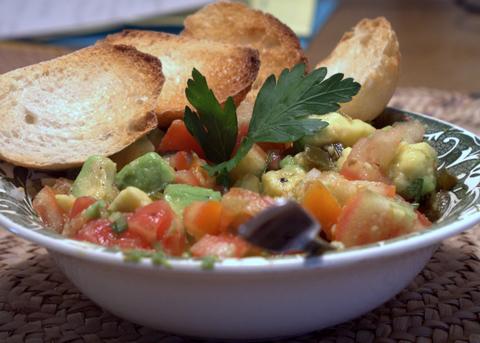
We put together a salad of avocado and tomatoes that, although the essence of simplicity, was entirely satisfying. Along with some rolls from the day-old shelf at BJ’s —sliced and toasted as crostini—we had a delicious lunch.
Avocado & Tomato Salad
Ingredients:
1/2 Large Florida Avocado, cut into small cubes
1 Med. tomato, coarsely chopped
1 Pickled jalapeno, minced
1/2 tsp. grated lime rind
1/2 tsp. grated fresh ginger
6 fresh mint leaves, finely chopped
3 or 4 grinds from the pepper mill
1/4 – 1/2 tsp. salt
2 – 3 tsp. lime juice (the juice from approximately 1/2 lime)
1 Tbs. onion, finely chopped
Preparation:
Combine the avocado, tomato, jalapeno, lime rind, ginger, and mint leaves in a non-reactive bowl. Stir gently to mix. Add the pepper, taste for salt and add up to 1/2 tsp. as necessary. Add the juice of 1/2 lime and the onion.
Allow to sit at room temperature for approximately 1/2 hour before serving. Serve with toasted baguette, or, as we did, with sliced and toasted day-old rolls from BJ’s.
Serves two.
Monday Supper:
We were able to dissect nearly one pound of usable meat from the fish frame. (Here again, we have a couple of advantages: a very sharp multi-purpose carbon steel knife and the skills to use it.) While the meat we rescued was not pretty and would have been of no value to Whole Foods, it was ideal for our purposes; we marinated it in citrus and olive oil and made a delicious, elegant supper of ceviche.
Again, we served the ceviche with boiled red-skinned potatoes and a salad of Romaine and tomatoes.
Ceviche
Ingredients:
1 Lb. firm-fleshed white fish (again, we used halibut, but you’d do fine with cod or ocean perch)
1 Lemon
1 Red bell pepper, julienned
1 Small white onion, thinly sliced
1/4 Cup Flat-leaf Italian parsley, coarsely chopped
1 Small clove garlic, finely chopped
2 Tbs. Olive oil
Salt & freshly ground black pepper
2 Bay leaves
Lettuce for serving (optional)
Preparation:
Cut the fish into bite-sized chunks and place in a non-reactive bowl. Grate the zest of the lemon over the fish, then cut the lemon in half and squeeze the juice into the bowl. Toss to coat all the fish pieces. This begins the process of “cooking” the fish.
Add all the remaining ingredients and stir well. Cover the bowl and refrigerate for at least one hour ( and up to 24 hrs.) before serving.
Stir again before serving and plate atop coarsely torn Romaine.
Serves four as a starter, two as an main course.
Links to the other posts in our series:
Living on $42.00 Per Week—the Challenge
Living on $42.00 Per Week—Day 1
Living on $42.00 Per Week—Day 3
Living on $42.00 Per Week—Day 4
Living on $42.00 Per Week—Day 5
Living on $42.00 Per Week—Day 6
Living on $42.00 Per Week—Day 7
Living on $42.00 Per Week—Summary
Living on $42.00 Per Week—Redux
Living on $42.00 per Week
July 15th, 2007You may have recently read about a couple of state governors and a congressman or two who have taken up the challenge of living on $21.00 per week for food. That’s the food budget currently available to someone eligible for Federal Food Stamps. We’ve been giving this serious thought and have decided to take up the challenge for ourselves.
For the next week, we’re going to contribute our experiences—what it’s like to live on $21.00 per week. There are two of us, so for this experiment, we’re going to assume that our household is entitled to food stamps and allow ourselves $42.00 for the week.
One of the congressmen, Tim Ryan (D, Ohio), has taken his challenge so far as to eschew lunches at the Capitol—a legitimate perk for all members of Congress. Rep. Ryan’s self-imposed austerity means he will also forgo the comestibles at the fundraisers and cocktail parties that are part of his weekly Washington beat.
We confess we’re less likely to turn down a meal or snack, should we be invited. But we will remember that most people dependent on food stamps do not receive the invitations we get for art gallery openings and wine tastings, where the hors d’oeuvres can be substantial.
We begin this social experiment with an advantage over many food stamp recipients who live with the real threat of hunger and malnutrition. Food is our métier. We’re cooks and we both grew up in families that sat down together for meals virtually every night. We watched our parents and grandparents grow and prepare food. Today, we are self-employed writers who focus on food and culture. We conduct cooking classes, and one of us has worked in a professional kitchen.
The pleasure of food—the buying, preparing, and sharing—is a focal point in our lives. And because we work from home, we try to make time to sit down together for a meal twice per day. We may take breakfast on the run, but lunch and dinner are sacrosanct—times to enjoy conversation as much as the food prepared, however simple the meal may be. And sometimes, it’s very simple—avocado mashed on toast…a hard-boiled egg and tomato salad…
Our everyday meals tend to be what popular media would term “Mediterranean”—in our case, mostly Middle Eastern and Italian. But because we’re both omnivores without food allergies, virtually nothing is off-limits for us. We make frequent forays into Indian, Chinese, and Caribbean cooking as well. And while one of us can inflict serious damage on the dessert bar at an all-you-can eat buffet, neither of us eats a lot of sweets.
Nevertheless, we’ll do our best to stay within the guidelines, and we’ll post our results frequently—at least every other day. Included in our posts, will be recipes for some of what we’ve prepared. We’ll also report any trips for food shopping.
We have a few other advantages over most in real need. As foodies, we begin with a well-stocked larder. For a week’s cooking, we won’t need to buy olive oil, garlic, spices, dried herbs, mustard, vinegar, flour, or many other common pantry items. We already have coffee and tea. Some 1% milk, eggs, and cheese are already in the fridge, and we’ll try to account for those within our $42.00.
Another favorable factor: we own cars. They give us a huge advantage over someone who needs to seek alternative transportation for grocery shopping. As drivers, we can shop at the Red Barn in Bradenton, where a week’s supply of fresh produce can cost less than $10.00. And although it may not be very significant for this short-term challenge, we have a membership at BJ’s. We note it here, because it’s where we bought that 3-litre bottle of Spanish extra-virgin olive oil and the 4 lbs of day-old Ecce Panis ciabatta bread, now in our freezer.
Finally, we have a kitchen—the refrigerator, stove, oven, toaster-oven, and microwave all work. Though we can always pay our bill with FPL, we are frugal with our use of energy.
Links to the rest of the posts in our series:
Living on $42.00 Per Week—Day 1
Living on $42.00 Per Week—Day 2
Living on $42.00 Per Week—Day 3
Living on $42.00 Per Week—Day 4
Living on $42.00 Per Week—Day 5
Living on $42.00 Per Week—Day 6
Living on $42.00 Per Week—Day 7
Living on $42.00 Per Week—Summary
Living on $42.00 Per Week—Redux
Palmetto-Roasted Peppers
May 13th, 2007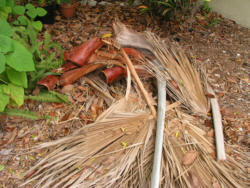
One of the great culinary finds for me here in Sarasota has been palm fronds. It turns out that they make excellent fuel for the Webber grill.
Of course, the price is right, and availability is no problem. I rarely need to forage farther than the street where I live to find an adequate supply. Once cut to size, the ribs and bases of the palmetto ignite with a piece of crumpled newspaper, and they burn at a very high temperature.
I’ve found one drawback, and that’s predictability. It seems some palm fronds burn faster than others. So I’ve remedied that by adding a half-dozen hardwood charcoal briquettes to the fire.
For grilling meats, the smokiness is great. I find it as distinctive as hickory or maple. But I’ve found another characteristic of palmetto that is unparalleled in my previous experience: it’s superb fuel for roasting bell peppers.
I’ve had problems in the past with either all hardwood briquettes, or with various other types of wood, where the peppers’ skins would simply fuse with the flesh. In five batches of peppers of varying size and thickness now, the charred skin peels off quickly and easily. In fact, for me anyway, palmetto has given new life to an Italian classic.
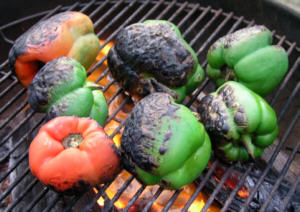 Roasted peppers are a staple of the southern Italian antipasto platter we all know, but they also make a terrific addition to sandwiches such as a panino prosciutto and mozzarella. Tony restaurants have recently been featuring roasted peppers in soups with tomato and basil. Roasted peppers are also the sine qua non for a dish of Pasta alla Napoletana.
Roasting peppers is not rocket science. You need only a charcoal grill or a broiler to roast peppers. Then it’s just a matter of shepherding them though the process. This is a time, though, to give complete attention to the task at hand.
One moment too long on the grill yields pepper-flavored charcoal. So let the phone ring through to voicemail, and free yourself from other potential distractions for several minutes, and you’ll be rewarded with one of the great treats of the Italian table.
Notes:If you’re using palm fronds, use the ribs and base only. Cut the top, leafy part away, and bring it to the curb on yard waste day.
In the recipe that follows, I’ve simply made reference to a charcoal fire. Of course this will work with all charcoal, or under the broiler in your kitchen too.
Ingredients:
4 – 6 Sweet bell peppers
4 Cloves garlic, peeled, and thinly sliced
1 Tbs. Capers, washed, and drained
4 Anchovy filets, preferably dried, salted anchovies, rinsed, drained, and chopped into quarter inch pieces
Olive oil
Salt & freshly-ground black pepper
Preparation:
Start a fire in a charcoal grill, or pre-heat the broiler. When the fire is ready, add the peppers without crowding them. Allow them to char on the side facing the fire, inspecting them from time to time. When the skin has blackened and has begun to bubble away from the flesh, turn them to expose another uncooked surface to the fire. Continue cooking them in this manner until they are uniformly blackened all around, then, stand them on end to blacken them top and bottom.
As each pepper is done, remove it to a paper bag to rest. When the last pepper is done and added to the bag, seal the top by folding it over several times, and allow the cooked peppers to rest for fifteen minutes.
For peeling the peppers, I observe a tradition I learned from my grandfather: I open a newspaper and simply rub the skins off onto the sports section. You could do it over a sink or a wastebasket, but do it in a place where you can control where the skins go. In his later years, my grandfather was also notorious for getting charred pepper skins all over the kitchen cabinets. If you find a particularly tough piece of skin that won’t come off easily, try loosening it with the back of a paring knife; failing that, try a vegetable peeler.
When the peppers are peeled, cut off their tops, then remove and discard the seeds and pod. Cut the peppers lengthwise into strips about one inch wide and place in a glass or ceramic bowl. Add the garlic, capers, and anchovies. Toss to combine the ingredients, then add enough olive oil to coat the peppers. Don’t soak them; just coat them with the oil. Taste for salt and pepper, and add them to your taste. Leave the peppers to marinate at room temperature for two hours.
If you’re not going to use the peppers immediately, cover the bowl with plastic wrap, or transfer to a glass jar and store them in the refrigerator. The peppers will keep, refrigerated, for at least a week.
The peppers will be adequate as a component of an antipasto for twelve, or make sandwiches for six. But if there’s a good ball game on television and you have a loaf of good Italian bread and you’re all alone…well, all bets are off.
(Another reason) Why I Love Sarasota
May 5th, 2007Of course wine tastings in convenience stores must happen elsewhere, but not in New England, where I’ve been most recently. On the surface, it must seem bizarre to think about tasting wines among aisles of Doritos, beef jerky, and lighter fluid. And my imagination certainly runs wild at the thought of what kinds of wines might be on offer for tasting.
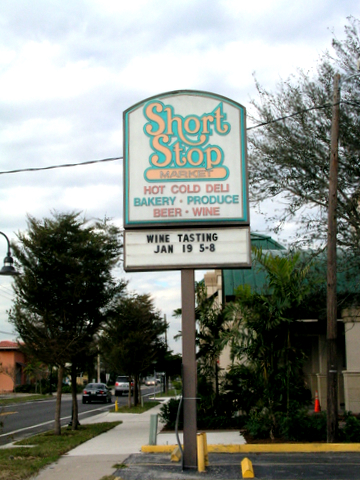
I’m told, though, that this convenience store often carries wines from—for example—Coppola Wineries…and at a discount below retail!
Well, I may have missed this one, but I’ll be watching to see if management organizes another for February. I must say, I love this town.