Florida Foraging 101
August 9th, 2007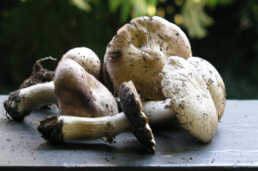
We’re not new to foraging. Back in Connecticut, we found (but kept silent about) a few neighborhood glens where mushrooms spring up after an autumnal rain. At first, we found mostly puffballs and campesters (the wild version of the button mushrooms in every supermarket). Once in a while we collected something that looked like porcini (aka boletus edulis), but were not always 100% sure. And because the margin of error in mushroom identification is slim, we had our share of anxiety until we bought a graphically precise mushroom field guide and met a veteran forager (who, thanks to his Polish DNA, is programmed to hunt for fungi after Labor Day). Soon enough, we were gathering enough mushrooms for a proper dish of pasta alla boscaiola, woodsman’s-style pasta. It was delicious. We felt we had put the ‘bosca’ back in boscaiola.
But since we’ve lived in Sarasota, we’ve been more mycologically challenged. We showed a couple of specimens to a friend who works at Selby Gardens. He studied our find through his loupe and muttered something about pores rather than gills without making a judgement; this did little to bolster our confidence. Needless to say, we changed our dinner plans.
Our fruit foraging has been more productive. Unlike virtually all our neighbors, we don’t own a dog. But whenever we go out for an evening stroll we bring a plastic bag, just in case something delicious has tumbled down to the side of the street. Surinam cherries, loquats, white sapote, calomondins…all edible—and ignored—in our vegetation-blessed neighborhood. Our only competition for this bounty are the local squirrels and less savory fruit rats. Beating them at their game adds a certain frisson to an already pleasant walk.
Certainly oranges have been easy enough to acquire. Even though our own back yard is home to several citrus trees, we do supplement our harvest with occasional evening forays. This is often necessary because the squirrels awaken before us and seem to enjoy starting their day with fresh OJ as much as we do.
One member of this partnership has proposed a rodent resettlement initiative. This would involve a couple of Haveahart traps and an evening drive “out east of I-75.” The plan has not gained unanimous support in our household legislature, so the proposal may have to be reintroduced during the fall fruit session; in any event, our next crop of oranges won’t ripen until November.
On the other hand, grapefruit are abundant for two reasons: 1) Most grapefruit are too large to be hauled off even by the most optimistic squirrel, and 2) half of Sarasota seems to be on Lipitor ®, for which grapefruit consumption is contraindicated.
If you follow food trends, you know that Alice Waters and her chefs at Chez Panisse have put the Meyer lemon on a culinary pedestal. It’s with good reason that this exceptionally juicy and fragrant citrus of low acidity is so prized, and we were thrilled to discover an old Meyer lemon tree on one of our trade routes. On the edge of a lot where a house was to be leveled, it was laden with fruit last year. We were looking forward to another lemon season, and it never occcured to us that after knocking over the house, the developer would also bulldoze every tree on the property! We’re still in mourning.
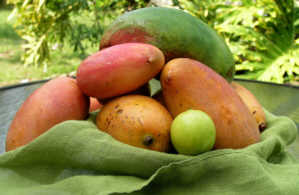
Mango season is in full swing now, and again, we’re astounded that so much fruit is simply lying on the ground. We found one mango that weighed nearly three pounds and dozens of others in the 14-oz. range. Here again, we are in competition with local wildlife. But caveat, fellow foragers! We won’t gorge ourselves on mangoes the way we did last year. One of us is allergic to poison ivy and found that excessive mango intake can trigger an itchy rash—not as discomfitting as poison ivy—but enough to make us look up the botanical family of Anacardiaceae, whose members include cashew, poison ivy, and…mangoes.
Exercising some restraint, we’ve been enjoying mangoes as a simple breakfast salsa. We wash our mangoes and then skin them with a carrot-peeler. We then rinse both the fruit and our hands—the resin from the skin contains most of the chemical allergens. Having cut the flesh into small chunks, we mix it with a little salt, freshly milled black pepper, red pepper flakes, juice from foraged limes, and coarsely chopped Thai basil. That, with some whole-grain toast, is a beautiful breakfast. We sometimes add grated ginger root and lime rind—but the mangoes are so delicious right now that we don’t have to do much.
Jazz at the Airport
August 8th, 2007Sarasota-Bradenton Airport: a Tuesday in August, 11 a.m. The temperature on the tarmac is 94 F. and rising. But inside the arrivals hall there’s a buzz—and it’s coming from something much cooler than air conditioning. For the month of August, arriving passengers (and those waiting to meet them) will be soothed by some of the finest jazz on the Gulf Coast.
Non-aeronautic diversions are nothing new for airports: bookstores, shoe-shine stands, 15-minute massage therapists… SRQ’s stars are swimmers, Mote Marine’s live leopard sharks. But now, the sharks have competition.
Bradenton Area Convention & Visitors Bureau executive director, Larry White is a big jazz fan. So big he has included the cavernous spaces of SRQ as a venue for the Bureau’s “Jazz on the Islands” series.
Twice each day through the entire month of August, from 11:00 a.m.—1:00 p.m. and from 3:30 p.m.—5:30 p.m., incoming passengers will be surprised to hear live jazz played by some of Sarasota’s most sophisticated musicians.
While it’s not yet apparent exactly how airport jazz is being received (a lot of arriving passengers come through talking on their cell phones), we gleaned the following comments between Tom Carabasi’s driving samba beats: “…a lot better than Fort Myers,” and “this place [SRQ] is a country club compared to Tampa.”
Dean of Sarasota jazz pianists and program coordinator, Michael Royal, has enlisted a Who’s Who of local performers. Rick Peterson, Tom Carabasi, Marc Mannino, Mark Neuenschwander, and Gary Goetz will rotate throughout the month, goodwill ambassadors for both arriving and departing passengers. Meanwhile, we defy anyone to find more mellow TSA agents than those at SRQ.
As we get farther into the rainy season here, sudden downpours can douse even the hottest outdoor concerts. So it’s exciting that Larry White’s creative, out-of-the-box thinking has tapped two of our great resources: a pool of extremely talented musicians and our superlative (and underutilized) airport.
Now, let’s figure out a way to perpetuate the program so that high-season travelers can also experience the theraputic benefits of jazz on the concourse.
Sipping at Short-Stop
August 4th, 2007
Just a quick note about the unexpected pleasures of a stout and ale tasting at the Short-Stop on Orange Avenue. It may be hard to imagine having an organized tasting of anything more sophisticated than beef jerky at a convenience store. But this is no ordinary convenience store.
The formerly generic, quick-in-and-out Short-Stop now devotes half its floor space to wine, including some very prestigious labels. The beer selection has grown far beyond long-necked Buds. Owner Ali Molavi, has taken his enterprise in new directions and has started to host monthly tastings. Last night, distributor J.J. Taylor was pouring seven distinctive specialty beers.
Though many beer aficionados lack the verbosity of wine tasters, mention of soy, peanut, smoke, espresso and citrus notes were heard. Vocabulary is fostered by connoisseurship, and we think any effort that makes us think about what we eat and drink is good.
The sampling included Wolaver’s Organic Brown Ale from Vermont and Brooklyn Pennant Ale. We were especially taken with the extremely hoppy Two-Heart Ale and the dense, bitter chocolate qualities of Kalamazoo Stout—both from Bell’s of Kalamazoo, Michigan.
Of course, if you want a long-necked Bud and some beef jerky, you can still find them here.
521 South Orange Avenue
Sarasota, Florida
941.955.6881
Living on $42.00 per Week-Summary
July 25th, 2007From the moment we first heard about Congressmen giving up cocktail parties so they could stick to the Food Stamp diet, we asked ourselves if we could live on $42.00 worth of food each week. We knew the answer to be yes, but we decided to document the effort. Last week, we shopped and cooked as if we, too, had to get by on food stamps. Here in Florida, that means $21.00 per week for each eligible household member. Our household is comprised of two food writers who love to cook.
We began our week-long experiment on Sunday, July 15, with $42.00 and the smugness of insiders. We ended our week on Saturday night with a steak on the grill and $5.46 remaining. Today, we’re talking about how we did it; whether we could sustain our enthusiasm if the dependency were real; and what we could have done better.
As we studied the Web pages describing how others had attempted to meet “The Food Stamp Challenge,” we noted that many of the participants didn’t cook. They simply went to a grocery store and bought the cheapest food they could find.
Recently the restaurant critic at one of Sarasota’s alternative newspapers did a feature on “The Food Stamp Challenge.” The author contrasted his own food choices with those of two young women with children, who really do receive food stamps. By his own admission, the critic’s synthesized experience was not a happy one. The women, who did not go into great detail about their meals, seemed to have worked our strategies for meeting their personal needs.
We suspect that most of the public figures participating, unlike the food-stamp mothers, didn’t spend the sort of time we did thinking about how one would shop and prepare a week’s meals. Political office-holders have other agendas. Furthermore, we started our project with significant advantages over most who had attempted this challenge before us.
• We’re foodies. We cook—from scratch, and we actually like grocery shopping and creating meals. For people like us, hunting for food bargains can be as much fun as yard sales and Ebay are for others.
• We’re informed—over-informed, some might say—about food issues, nutrition, and myriad ways to prepare food. Our favorite lunchtime conversation is, “What shall we have for dinner?”
• We began the week with a well-stocked larder: among other staples, we already had our bargain-priced 3-litre bottle of extra virgin olive oil (e.g., we did not have to lug it home in a folding shopping cart in 92 F. heat nor did we have to drive to BJ’s to buy it.) Nevertheless, if we dipped into the pantry for something that made a significant contribution to our diet (the milk for our coffee, olive oil, bread we had frozen),we deducted its cost from our budget as if we had actually purchased it with our Food Stamp funds.
• Because we own cars, we’ve no problem getting to the Vietnamese grocer on Fridays when he has fresh, whole kingfish. Or swinging into a Publix parking lot because it’s an easy right-hand turn and we just remembered their 2-for-1 special on canned garbanzo beans.
• We live an easy drive from an open-air produce market where we can buy more than a week’s worth of produce for approximately $11.00.
So how was our week? Were we preoccupied with food? Absolutely, but then, because of our professions, we usually are. However we were not hungry between meals, and very satisfied as we made and consumed them. Certainly, we needed to be attentive to what we planned to eat and to whether or not we’d need to draw down our allotment. We cooked and sat down to eat two nourishing and delicious meals every day. We didn’t feel the need to snack, except for a few handfuls of sunflower seeds.
We suffered no symptoms of fatigue or cabernet sauvignon withdrawal. Of course, wine isn’t eligible for the food stamp budget anyway, but it does soothe hunger. And although we often have wine with dinner, to play fair, we didn’t consume any during the challenge. To sum up, we did well, extremely well, and ate pretty much as we usually do.
A nutritionist we know checked in during the week to tell us that she absolutely loved our food journal and intended to direct her entire mailing list to our blog. If she were more doctrinaire, she could have scolded us for not eating a “balanced” breakfast. But, if our mothers couldn’t do it when we were teenagers, we’re even less likely to start eating oatmeal or scrambled eggs now. We do eat those things—just not at the hour most folks do.
In a typical week, we might have one or possibly two meals with meat as the focus. The key word here is might. Certainly the Sicilian member of this partnership feels that there is no such thing as too much pasta. And our culinary repertoire includes scores of dishes that pay our respects to the Holy Trinity of vegetarians everywhere—beans, greens and starch—be that rice, barley, bulgur, potatoes or pasta. We’ve gone days without more meat than an ounce of pancetta in some pasta alla carbonara. But when we do make meat the main event, it’s almost never a New York strip or loin lamb chops.
We are big fans of lesser cuts over American favorites like rib-eye steaks and loin lamb chops. Our choices are not out of economic necessity nor because we have our grandmothers’ recipes for things like tripe, but because many inexpensive cuts of meat are, simply, the most flavorful.
Short ribs and oxtail have been discovered by the foodie community, and their prices have risen. But beef cheeks are still a bargain. How weird can they be if Mario Batali is getting $23.00 per portion? As omnivores, we shop low and eat high. Nothing is off-limits, neither offal, nor meatless meals.
One thing we felt we couldn’t do during the challenge was take full advantage of supermarket sales. This might be have been the hardest thing we faced all week: beef chuck shoulder steak was only $1.49 per pound at our local Sweetbay during the challenge. Ordinarily, at that price, we would have bought one steak for immediate use and a second to freeze. But as we thought we should keep some funds on reserve, we bought only one.
Could we sustain the Food Stamp Challenge? Of course we could, but we’ve already confessed our own ‘unfair’ advantages. Eventually, we’d need to replace items depleted from our pantry. Even a small bottle of good olive oil could wreak havoc with a budget as austere as this. But if we were to really feel the pinch, we could eat more meatless meals, and it would be no hardship to eat more pasta. And since it is midsummer, we’ve barely dipped into the repertoire of hearty pulse and grain combinations that occupy our thoughts and table during cool weather. So was this week even a “challenge” for us? Not really.
Does this mean we think the U.S. Government’s food stamp program is adequate? No way—but our reasons for claiming the deficiency have less to do with money than with education and eligibility. We’ll expand our ideas on this topic in a post within the next few days.
Our thanks again to Derrick at Obsession With Food for mentioning us on his blog. We’d like to see more food bloggers take up the Food Stamp Challenge. We’d love to have the insights and recipes that come out of other bloggers’ kitchens during a week of living on the food stamp budget. Please let us know if you join the experiment. We’ll put a link to you on our blog.
Links to the other posts in our series:
Living on $42.00 Per Week—the Challenge
Living on $42.00 Per Week—Day 1
Living on $42.00 Per Week—Day 2
Living on $42.00 Per Week—Day 3
Living on $42.00 Per Week—Day 4
Living on $42.00 Per Week—Day 5
Living on $42.00 Per Week—Day 6
Living on $42.00 Per Week—Day 7
Living on $42.00 Per Week—Redux